
(present simple tense)
PRONOUNS AND AUX
PRONOUNS AND AUX
HE ----- DOES
SHE ------ DOES
IT -------- DOES
THEY ------- DO
WE --------- DO
YOU -------DO

PRESENT
STRUCTURE
- (?) AUX + SUBJECT +
VERB + COMPLEMENT
- (-) SUBJECT +AUX NOT
+ VERB + COMPLEMENT
- (+) SUBJECT + AUX +
VERB + COMPLEMENT
EXAMPLES
(?) DO THEY WORK IN THE OFFICE?
(-) THEY DONT' / DO NOT WORK IN THE OFFICE
(+) THEY WORK IN THE OFFICE

STRUCTURE
| ||
Affirmative
|
sujeto + verbo (infinitivo)
|
You study English.
|
Negative
|
sujeto + do/does + not + verbo (infinitivo)
|
You do not study English.
|
Interrogative
|
do/does + sujeto + verbo (infinitivo) ?
|
Do you study English?
|
Interrogative Negative
|
do/does + sujeto + not + verbo (infinitivo) ?
|
Do you not study English?
|
RULE FOR HE, SHE, IT IN AFFIRMATIVE
YOU MUST ADD (S) THE VERB, ONLY AFFIRMATIVE PRESENT
EXAMPLE
(+) HE WORK(S) IN THE OFFICE
(-) HE DOESN'T WORK IN THE OFFICE
(?) DOES HE WORK IN THE OFFICE?
Pronombre
|
Verbo
|
I/you/we/they
|
love, like, swim, eat
|
he/she/it
|
loves, likes, swims, eats
|


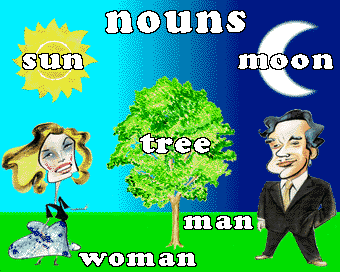
What are Nouns?
The simple definition is: a person, place or thing
teacher, school, book
Countable Nouns, Uncountable Nouns
Why is this important? Why do some nouns have no plural?
dog/dogs, rice, hair(s)
Proper Nouns (Names)
Do we say "Atlantic Ocean" or "the Atlantic Ocean"? Should I write "february" or "February"?
Shirley, Mr Jeckyll, Thailand, April, Sony
Possessive 's
Adding 's or ' to show possession.
John's car, my parents' house
Noun as Adjective
Sometimes we use a noun to describe another noun. In that case, the first noun is "acting as" an adjective.
love story, tooth-brush, bathroom
Compound Nouns
A compound noun is a noun that is made with two or more words.
tennis shoe, six-pack, bedroom
exercises


No hay comentarios:
Publicar un comentario